


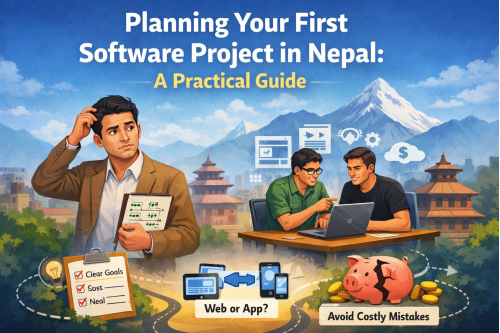
Why Most Software Projects Fail
In Nepal, more and more businesses are trying to go digital. A shop wants an eCommerce website, a consultancy wants a client management system, and a startup wants “an app like Pathao or Daraz.”
The intention is good — but the execution often goes wrong.
Globally, research shows that only about 30% of software projects are fully successful, while many are delayed, over budget, or fail to deliver expected results (Standish Group, 2020). Around 70% of digital transformation efforts fail to meet their goals (BCG, 2020). The exact numbers may vary, but the pattern is clear — many projects do not deliver what founders expect.
In Nepal, this becomes more challenging because founders understand their business well but lack technical knowledge. They depend heavily on developers or vendors, which creates a gap between expectation and execution. Most failures happen inside this gap.
Software projects don’t fail because of technology.
They fail because of poor planning, unclear expectations, and wrong decisions.
Why Non-Tech Founders Struggle
Most non-technical founders don’t fail because they are careless. They struggle because they approach software the wrong way.
One common issue is thinking in terms of features instead of processes. Founders often say they need a dashboard or a mobile app, but those are outputs, not solutions. What really matters is the problem being solved and how the business process improves.
Another challenge is over-dependence on vendors. Many founders expect developers to “figure everything out,” but developers understand technology — not your business. Without proper input, they rely on assumptions, which often leads to incorrect results.
In Nepal, this situation is more complex because there is no standard pricing and quality varies widely. Many vendors overpromise to win projects. This makes it difficult for founders to evaluate what is right.
The root problem in most cases is lack of clarity.
Mistake #1: Not Being Clear About the Transformation
Output vs Outcome
Output is the system you build a website, app, or software. Outcome is the improvement in your business. Many founders ask for an eCommerce website, but their real need may be reducing manual orders, tracking sales, or managing delivery.
For example, a shop owner builds an online store. After launch, orders still come through phone calls, inventory is not updated properly, and delivery is disorganized. The website exists, but the business has not improved.
Instead of asking “What should I build?”, a better question is “What problem am I solving?” Unclear requirements are one of the biggest causes of software project failure.
If you cannot clearly define the improvement you expect, you are not ready to start.
Mistake #2: Choosing Cheap or Unknown Solutions
Many founders choose the cheapest developer, the fastest promise, or an unknown SaaS tool. At the beginning, this feels like a smart decision, but it often creates long-term problems.
Low-cost solutions usually come with trade-offs. There may be limited planning, poor structure, no documentation, and weak support. Over time, these issues lead to rework, delays, and additional costs. Globally, IT projects already run about 27% over budget on average, and poor early decisions are a major reason.
SaaS tools are another common trap. They are quick to start and affordable, but they come with risks. Your data depends on the provider, customization is limited, and migrating later can be difficult. If the service shuts down or changes pricing, your business is affected.
Instead of asking “Who is cheapest?”, a better approach is to ask “Who understands my problem properly?”
Cheap decisions often become expensive later.
Mistake #3: Not Providing Proper Input to Developers
Many founders assume that once they hire a developer, everything will be handled. In reality, developers cannot understand your business unless you explain it clearly.
If you say you need an order management system but cannot describe how orders come, who handles them, and what happens next, the developer will make assumptions. These assumptions often lead to incorrect systems.
This results in changing requirements, repeated work, increased costs, and frustration on both sides. Poor communication and lack of clarity are major contributors to project failure.
For example, a logistics company builds a tracking system without clearly defining its internal process. Staff do not use the system properly, data becomes incomplete, and reports are unreliable. The system exists, but the business problem remains.
The quality of your input directly affects the quality of the system.
How to Explain Your Idea (Without Technical Terms)
Many founders try to use technical terms like dashboard, backend, or API, but this often creates confusion.
A better approach is to explain your idea as a process. Think of it as explaining your work to a new employee. Focus on what should happen step by step.
A simple method is:
“When X happens → I want Y → then Z should follow”
For example, instead of saying “I need CRM software,” you can explain how a client inquiry should be handled, followed up, and tracked until conversion.
You don’t need to know coding.
You need to explain your business clearly.
Web vs Mobile App: What Should You Build First?
Many founders believe they need a mobile app because it feels modern and professional. However, building an app is more expensive, complex, and difficult to maintain.
For most early-stage businesses, a web-based system is a better starting point. It works across devices, is faster to develop, easier to update, and costs less. It also allows you to test your process and improve your system before scaling.
Mobile apps make sense when users need frequent interaction, real-time updates, or customer-facing features. But if your process is not yet clear, starting with an app can lead to unnecessary complexity.
If your process is unclear, start with web.
Custom Software vs SaaS
SaaS tools are quick and easy to start, with lower initial costs. However, they come with limitations such as lack of control, vendor dependency, and limited customization.
Custom software, on the other hand, is built specifically for your business. It offers flexibility, scalability, and full control over your data. But it requires more time, planning, and investment.
A practical approach is to use simple tools in the early stage to validate your process, and then move to custom software as your business grows.
Don’t build too early.
Don’t depend too long.
Red Flags When Choosing a Vendor
Choosing the right vendor is critical. Many founders focus on price or speed, but this often leads to poor decisions.
Watch for these warning signs:
- No clear proposal or scope
- No timeline or milestone breakdown
- Pricing significantly lower than others
- No documentation or written agreement
- No discussion about maintenance
A good vendor will ask detailed questions about your business process before proposing a solution.
Choose a vendor who asks more questions than you do.
A Simple Planning Framework
Before starting your project, follow a clear process.
Start by defining the problem you want to solve. Then map your current process step by step. After that, define how the process should ideally work.
Next, prioritize features by separating must-have from nice-to-have. Decide whether to build a web or mobile solution based on your actual needs. Finally, choose between SaaS and custom development, and select a vendor based on understanding — not just price.
You don’t need a perfect plan. You need a clear starting point.
Quick Checklist
- I can clearly explain the problem
- I have written my process step by step
- I know how I want it to improve
- I have identified must-have features
- I chose web vs mobile based on need
- I understand SaaS vs custom
- I will evaluate vendors beyond price
- I will document everything